Why Bad Attic Ventilation Destroys Your Roof
Bad attic ventilation is quiet, steady damage. It shortens the life of shingles, rots the roof deck, and breeds mold that spreads into living space. In Seattle and across King County, where rain is heavy and winters are long and damp, a roof that cannot breathe fails early. A local roofing contractor who understands Western Washington moisture and heat patterns treats ventilation as a core part of every roof installation, roof repair, and roof replacement.
Atlas Roofing sees the same pattern from Renton to Bellevue, from West Seattle to Kirkland. Heat builds under the roof in summer, even in a mild climate. Moist indoor air rides up into the attic during the wet season. Without balanced intake and exhaust, that heat and moisture sit against the wood and the shingle underside. The result is premature roof failure, often years before a homeowner expected to talk to a roofing company about new shingles.
What ventilation failure does to a roof in Western Washington
Ventilation failure is two problems at once. First is heat. Sun warms the roof surface. The attic traps that heat. Shingles cook from below. Asphalt softens, which speeds granule loss. Granules are the mineral layer that protects shingles from sun and rain. When they shed fast, the mat shows through and water wins.
Second is moisture. Warm indoor air holds water vapor. That air moves up through small openings in ceilings and light fixtures into the attic. When that moisture meets cold roof sheathing in fall and winter, it condenses. Condensation is water forming out of vapor when a surface is at or below the dew point, which is the temperature where air can no longer hold all its moisture. Condensation wets the plywood, rafters, nails, and insulation. Wet wood grows mold and loses strength. Wet insulation collapses and stops insulating.
In homes from Ballard and Magnolia to the Highlands in Renton, poor attic air movement also raises energy bills. In summer, trapped heat pushes air conditioning harder on warm days. In winter, damp insulation loses R-value, which is its resistance to heat flow, so the furnace runs more.
At higher King County elevations like Issaquah and Sammamish, freeze and thaw cycles hit wet roof decks hard. Moisture in the wood expands when it freezes. That movement opens fastener holes and cracks the decking. Shingle tabs then lift in wind events off I-90 or the Plateau. A winter wind-lifted ridge cap becomes a roof leak by spring.
Damage modes a local roofing company documents again and again
Property owners often see only the symptom, not the ventilation root cause. Experienced roofers in Seattle, Bellevue, Redmond, and Kirkland see the chain of failure clearly. The common results show up on inspections and during roof replacement tear-offs across King County:
- Accelerated granule loss and brittle shingles from underside heat Dark staining or mold on the underside of the roof deck from condensation Rusting nail tips and frosty nails in winter, which drip onto insulation Delaminated or spongy plywood at eaves and valleys, where cold air and wet air meet Ice at roof edges in higher elevations that forms minor ice dams, then water back-up
These issues shorten the life of an asphalt composite roof. In Western Washington, a composite shingle roof often lasts in the range of 15 to 25 years depending on maintenance, exposure, and ventilation. Poor ventilation pulls a roof toward the lower end of that range. Good ventilation supports the higher end, and often longer, when the system and attic insulation are correct for the house.
How moisture gets into King County attics in the first place
It rarely takes a visible roof leak to load an attic with moisture. Everyday living drives humidity up. Showers, cooking, laundry, and even breathing all add water vapor to indoor air. The building physics that pushes that vapor up is simple. Warm air rises. That is the stack effect, which means buoyant air moves upward in a building and escapes through the upper leaks unless managed.
In houses across Capitol Hill, Queen Anne, and West Seattle, bathroom fans often vent into the attic by mistake or through damaged ducting. That dumps concentrated moisture into a space that cannot handle it. Kitchen range vents that stop short of the roof plane do the same thing. Recessed lights, unsealed attic hatches, and gaps around plumbing vents all let warm moist air move up into the attic during the wet season.
Without a way out through proper exhaust, and without steady intake at the eaves, that moisture condenses on the first cold surface it touches. In winter that is the roof sheathing. In shoulder seasons like late fall and early spring, repeated wetting and partial drying still damage wood structure over time.
Why the Seattle climate magnifies the ventilation problem
Seattle and the broader King County region see a long wet season. Rain falls often from October through April. Roofs stay damp for days between breaks in weather. Shaded north slopes grow moss on porous surfaces like composite shingles and cedar shake. Moss traps water, holds it against the shingle, and slows drying. That keeps roof decks colder and wetter, which increases the chance of condensation in the attic above those slopes.
The climate asks more from a roofing system than in drier markets. Good underlayment selection matters. Ice and water shield at eaves and valleys protects the deck from wind-driven rain and minor ice dam events, especially in neighborhoods near Lake Washington or at elevation. Synthetic underlayment resists moisture better than old felt in wet conditions. But even the best underlayment cannot solve an attic that cannot exchange air. Ridge vents and soffit vents have to work together on steep-slope roofs to move air through the cavity and keep the deck dry from the underside.
This local pattern is a shareable fact for any Seattle homeowner or property manager: long-duration rainfall and cool, damp shoulder seasons raise condensation risk in attics, which is why Western Washington roofs demand balanced intake at the eaves and continuous exhaust at the ridge more than comparable homes in the Sunbelt.
Balanced ventilation explained in plain English
A balanced system has two parts that work together. Intake brings outdoor air into the attic through soffit vents, which sit under the roof overhang. Exhaust lets warm, moist air leave near the top, most often through a ridge vent that runs along the roof peak. Balance means the net free area of intake and exhaust match so air flows evenly. Net free area is the open area after accounting for the screen or baffle inside a vent.
On many King County homes, continuous soffit vents feed a continuous ridge vent. The ridge vent hides under hip and ridge caps that match the shingle line from a manufacturer like GAF, Owens Corning, CertainTeed, or Malarkey. On homes without soffits, builders sometimes use a specialized intake at the roof edge under the first course of shingles. Each home needs a specific combination. Off-ridge box vents or gable vents can help in a mixed system, but they are not a substitute for an open ridge tied to good intake.
Roofers also protect the air path inside the attic. Baffles, also called rafter vents, are plastic or foam guides that keep insulation from blocking soffit openings where the roof plane meets the exterior wall. Good airflow across that lower edge keeps the entire roof deck supplied with fresh air, which then moves upward to the ridge and out.
The best time to correct ventilation is during a roof replacement. Crew access is easier. The ridge is open. Drip edge metal can be integrated at eaves to protect wood and support edge intake products where soffits are limited. Ice and water shield can be placed at eaves and valleys for Western Washington weather while the ventilation system is dialed in to the manufacturer’s specifications for the shingle being installed.
Roof ventilation, insulation, and air sealing work as a team
Ventilation alone cannot defeat high indoor humidity if warm, moist air pours into the attic through holes and ducts. A whole-roof approach ties three elements together. Ventilation moves air. Insulation slows heat passing through the ceiling. Air sealing blocks leaks between living space and attic. Air sealing is the simple act of closing gaps and holes with foam, caulk, or gaskets so air cannot move where it should not.
Bathroom fans must vent to the exterior with a hard duct and a roof cap that includes a damper. Kitchen range hoods need a dedicated duct and proper roof or wall cap. Duct joints need tape made for ducts, not cloth tape. Recessed lights should be airtight models or covered with insulated boxes rated for contact with insulation. Attic hatches need weatherstripping, and pull-down ladders need a cover box.
Atlas Roofing coordinates these details during roof replacement or repair work that touches penetrations. Proper pipe boot flashing, a skylight flashing kit, and counter flashing at chimneys protect penetrations while airflow and duct routes stay correct. Roof ventilation then finishes the job by moving air through the attic so the deck can dry and heat can escape.
Older Seattle-area homes present specific ventilation challenges
Many Seattle and Eastside houses were framed decades ago with details that were common then and tough today. 1940s and 1950s bungalows around Wallingford, Ravenna, and Beacon Hill often have small or blocked soffit cavities. The framing leaves little room for insulation at the eaves, which means airflow can choke unless baffles are installed carefully at each rafter bay.
1970s split-level homes in Renton’s Kennydale or Talbot neighborhoods and on Education Hill in Redmond sometimes mix shallow vented attics with vaulted sections. The vaulted parts need strategy because there is no open attic above the ceiling. Some of these roofs benefit from a vented nail base assembly or from controlled ventilation created by baffles that extend from low intake to high exhaust across the vaulted rafter space. Each case has to be checked from the soffit edge to the ridge to confirm a clear air path.
Newer townhomes in Capitol Hill and Fremont often lack deep overhangs, so there is little space for conventional soffit vents. An edge intake product at the lower course of shingles can supply air instead. A continuous ridge vent finishes the high side. This solves the geometry without altering the façade or violating an HOA standard.
Commercial buildings need moisture control even when roofs are flat
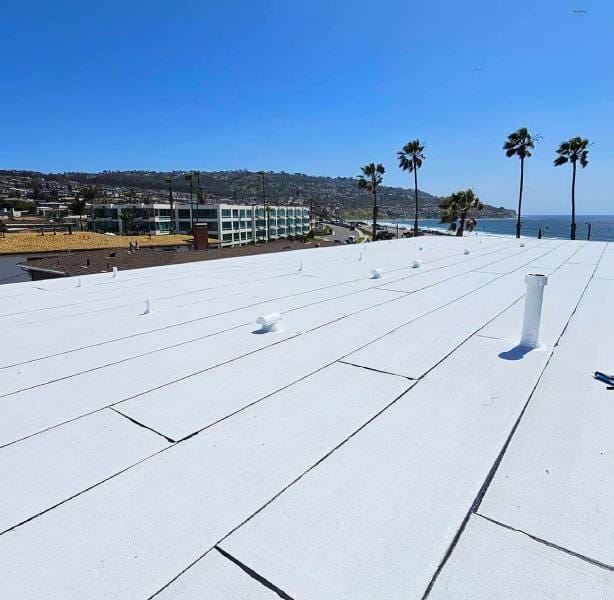
Commercial flat roofs across Seattle, Bellevue, and Tukwila do not use attic ventilation like a steep-slope home. They manage interior moisture with vapor retarders and insulated roof assemblies. TPO and EPDM single-ply membranes, hot mop built-up systems, and torch-down modified bitumen roofs all rely on correct insulation thickness and attachment method to avoid condensation under the membrane. Tapered insulation directs water to drains so ponding water does not cool the deck unevenly or stress heat-welded seams during freeze-thaw cycles.
Where a commercial building has a plenum or dropped ceiling under the roof deck, mechanical ventilation and dehumidification may be part of the solution. Rooftop HVAC penetrations and curb flashings must be tight. Poorly sealed curbs leak warm, moist interior air into the roof assembly and can cause blistering in a fully adhered membrane. A roofing company that installs TPO and EPDM across King County considers interior vapor control and drainage design together before proposing any repair or replacement.
Evidence property owners notice before calling roofers
In houses from Kirkland’s Finn Hill to West Seattle, the early signs are easy to miss until a ceiling stain appears. Many property owners only discover a ventilation issue during a real estate transaction or a routine roof inspection. A few cues point to ineffective ventilation and moisture stress inside the attic and at the roof edges:
- Sawdust-like debris on insulation that turns out to be mold growth on sheathing Curled or cupped shingles near the ridge, even when the field looks fine Heavy moss on north and east slopes while south slopes stay cleaner Wintertime frost on roof nails observed from the attic, which drips on warm-up Peeling exterior paint at eaves, a sign of trapped moisture moving outward
An inspection by a licensed roofing contractor connects these dots and checks the actual air path from soffit to ridge. It also confirms bath fan terminations and looks for blocked baffles. In many homes near Lake Washington or Lake Union, retrofitting a balanced system and correcting duct runs removes the root cause before installing new shingles or repairing weathered sections.
Ventilation during roof repair and roof replacement
A roof replacement is the ideal moment to correct attic airflow. Tear-off exposes the ridge and eaves. The crew can install continuous ridge vent, confirm open rafter bays, and add baffles where insulation formerly blocked intake. If the house has no conventional soffit space, the team can integrate a roof-edge intake product under the first shingle course. Drip edge metal then covers and protects the assembly.
Underlayment choice matters during this work. Ice and water shield at eaves, valleys, and dead valleys resists wind-driven rain and short-term refreeze near gutters in colder pockets of King County. Synthetic underlayment across the field resists moisture and maintains traction for safe installation in wet weather. On metal roof replacements, the standing seam profile itself sheds water and resists moss, which reduces exterior moisture load on the deck. Even then, attic ventilation remains important to protect the structure from interior moisture and to reduce summer heat buildup.
Cedar shake restorations and replacements demand special attention. Cedar is porous and grows moss in shaded areas. That keeps decks cooler and wetter from above. Balanced intake and ridge exhaust help the deck dry from the inside while the exterior ages. Tile and concrete tile roofs create larger air cavities under the tile itself. That can help exterior drying, but the attic still needs balanced airflow so interior moisture does not condense on the wood deck.
Integration with skylights, chimneys, and other roof penetrations
Skylights and chimneys interrupt airflow and are also frequent sources of leaks. During ventilation upgrades and roof replacement, proper step flashing and counter flashing re-establish water control at these penetrations. A skylight flashing kit from a reputable brand and correctly sized saddle flashing on the high side help water move off the unit and into the shingle field without turbulence that drives water back. When bath fans terminate near a skylight or chimney, the duct should route to a separate roof cap with a damper. This keeps moist exhaust air from recirculating into the attic or collecting in pockets around a penetration.
Pipe boot flashing at plumbing vents must match pipe size and material and be installed flat, not back-pitched. Back-pitching pushes water under the boot during heavy Seattle rain. New boots and caps are standard during a quality roof replacement. Confirming that each vent cap includes a damper prevents wind from driving cold air back into the duct and attic cavity during storms off Elliott Bay or Lake Sammamish.
Gutters, downspouts, and how drainage interacts with ventilation
Ventilation dries the attic from inside. Gutters and downspouts move water away from the roof edge outside. In heavy King County rain, undersized or clogged gutters overflow at the eaves. That keeps the lower roof edge and soffit wet. A constantly wet soffit reduces air intake efficiency and feeds rot at the fascia where drip edge meets the gutter line.
A roofing company that offers gutter installation and replacement will size K-style aluminum gutters to the roof area and slope. Many two-story homes in Bellevue, Kirkland, and Redmond need 5-inch or 6-inch seamless gutters with 3x4 downspouts and hidden hangers for strength. Correct drainage supports the ventilation system by keeping the intake zone dry and intact.
Local scenarios by neighborhood and exposure
In Ballard near the Locks, older cedar shake roofs under tall evergreens see heavy moss on north slopes. Moss holds water and keeps the deck cold, while interior humidity from tightly sealed homes drives condensation above that same slope. Balanced ridge and soffit ventilation, a careful moss removal plan for unaffected slopes, and correct underlayment selection prevent repeat damage when swapping to asphalt composite shingles.
On Somerset and Cougar Mountain in Bellevue, winter winds hit ridges hard. Wind-lifted ridge caps signal that hot attic air has been cooking the shingle underside, making it brittle. A continuous ridge vent with manufacturer-matched hip and ridge caps and improved intake below solves both the wind vulnerability and the heat problem.
Near Lake Washington in Kirkland and Renton’s Kennydale waterfront, damp air off the lake and frequent fog keep eaves cold and wet. Drip edge, ice and water shield at the eaves, and a tuned intake and exhaust path reduce condensation at the cold deck edge during fall and roof upgrades Renton winter.
In Queen Anne and Capitol Hill, many older homes mix finished attic rooms with partial vented cavities. Correcting airflow without opening finished ceilings takes experience. Roofers who work these neighborhoods often rely on continuous ridge vent on the main ridge, selective off-ridge vents where the ridge breaks, and edge intake products to feed air to bays without soffits, all verified during a roof inspection before work begins.
What ventilation improvement typically costs in general market terms
Every house is different, so exact pricing requires an on-site inspection and a written proposal. In general market ranges, correcting attic ventilation may run from a few hundred dollars for simple vent additions to several thousand dollars when combined with baffles, duct corrections for bath fans, and ridge vent work. When folded into a full roof replacement, many ventilation upgrades are more cost-effective because the crew is already opening ridges and working at eaves.
For a composite shingle roof replacement, general market pricing spans a wide range based on roof size, pitch, complexity, and material line from brands like GAF, Owens Corning, CertainTeed, or Malarkey. Flat numbers written without a site visit are not useful. The right way is a free estimate and a written proposal that ties ventilation, underlayment, flashing, and shingles into one scope built for Western Washington weather.
Inspection, documentation, and insurance connections
A roof inspection focused on ventilation checks the air path first. It also documents any storm damage for insurance. Wind damage that blows off cap shingles or rips ridge vents often exposes heat-brittled shingles below. Photos, measurements, and a simple map of the roof show where damage occurred and how ventilation contributed to the condition of nearby shingles. If an insurance claim applies for the wind event, documentation supports that file while the roofing contractor recommends a repair or a full roof replacement depending on overall roof age and condition.
For HOA and property management clients across the Eastside and South King County, consistent ventilation standards across buildings keep replacement cycles predictable. Matching ridge vents, standardized soffit vent details, and confirmed bath fan terminations reduce moisture problems that show up as staining on top-floor ceilings or mold calls from tenants during the winter.
Why property owners call a roofing contractor for this work, not an HVAC company
Attic ventilation ties directly to the roof system. Ridge vents integrate under shingles. Soffit intake depends on eave details, baffles, and insulation. Penetrations like pipe boots, skylight flashing, and chimney counter flashing are roofing-specific. A licensed roofing contractor controls these pieces during roof repair or replacement. HVAC companies manage interior air distribution and equipment, but attic airflow through the roof plane is a roofing job by design and risk.
Doing the right thing during new roof installation
During a new roof installation on a Seattle-area home, a careful sequence protects the structure and builds a roof that lasts. Tear-off exposes the deck so rotten sections can be replaced. Synthetic underlayment and ice and water shield are installed in the right locations for Pacific Northwest storms. Drip edge goes on correctly to shed water into new gutters. Balanced ventilation is created by opening the ridge and verifying open intake below. Shingles or panels go on to manufacturer specifications, whether architectural asphalt shingles or standing seam metal panels. Flashing at chimneys, skylights, and walls is replaced or upgraded. The result is a system built for rain, moss, and the interior moisture loads that define this region.
Local access matters for roofers serving King County
Atlas Roofing operates from Renton near I-405 and SR 167, with quick access to I-5, I-90, and SR 520. That reach covers Seattle neighborhoods like Ballard, Magnolia, Queen Anne, West Seattle, and Capitol Hill, and Eastside cities including Bellevue, Redmond, and Kirkland. Local knowledge matters for roof ventilation as much as it does for roof repair and installation. Knowing when Issaquah nights will freeze while Ballard stays above 40 degrees changes where to place ice and water shield and how to balance intake on shaded slopes. Seeing moss patterns around Lake Union or along the Lake Washington shoreline helps predict where roof decks stay colder and wetter.
Materials and methods aligned with the Pacific Northwest
For composite shingle systems, Atlas Roofing installs materials from major brands like GAF, Owens Corning, CertainTeed, and Malarkey. Those lines include ridge vent accessories and hip and ridge caps engineered to pair with the field shingles. For metal roofs, 24-gauge standing seam panels shed water quickly and resist moss adhesion, which reduces exterior moisture load, while balanced attic airflow still protects the deck.
On commercial work where ventilation is not the control point, TPO and EPDM membranes from brands such as Carlisle, Firestone, and Johns Manville perform well when heat-welded seams, tapered insulation, and correct attachment methods are matched to the building. Even there, interior humidity and vapor control are checked to prevent condensation inside the assembly.
Why poor ventilation is a preventable problem in King County
Most of the damage described here does not come from a defect in shingle manufacturing. It comes from construction details the original builder did not tune for the Seattle area, from blocked soffit vents, from missing ridge vents, and from bath fans that were never ducted to the exterior. The fix is straightforward for an experienced roofing company. Verify intake. Open and finish a continuous ridge vent. Add or correct baffles. Route fans to the exterior with the right caps. Replace damaged sheathing. Rebuild the roof with underlayment that suits Western Washington. This is not a guess-it-and-hope situation. It is a measured, practical correction that extends roof life and protects the home.
Serving Seattle, the Eastside, and King County from Renton
Atlas Roofing works across Seattle, Bellevue, Redmond, Kirkland, Renton, and neighboring cities like Issaquah, Sammamish, Mercer Island, Kent, Tukwila, and Auburn. The team understands the moisture load of the wet season and the way roof designs from different decades behave under that load. Whether a homeowner near Pike Place Market, a landlord off SR 520, or a facilities manager off I-5, ventilation is part of the roof conversation because it decides how long the system lasts.
Why property owners choose Atlas Roofing for ventilation-driven roofing work
Atlas Roofing is a Renton-based roofing contractor that treats attic ventilation as a core building system, not an afterthought. The company is a Washington State licensed contractor, license #ATLASRS758K1, and is fully insured. The team installs and services residential and commercial roofing including asphalt composite shingles, cedar shake, metal, tile, and flat roof systems such as TPO and EPDM. Services include roof repair, roof replacement, roof installation, roof inspection, roof maintenance, skylight installation, attic insulation, gutter installation and replacement, moss removal, storm damage repair, HOA and property management roofing, and insurance claim documentation support. Flexible financing options are available. Every job includes a free estimate with a written proposal and is backed by a material and workmanship warranty.
Property owners in Seattle, Bellevue, Redmond, Kirkland, and Renton who see signs of poor ventilation, plan a roof replacement, or want a roof inspection can schedule a visit. Call Atlas Roofing at (425) 728-6634 to book a free estimate and have the attic ventilation, underlayment, flashing, and roofing system evaluated for the Pacific Northwest climate.